.text ; disassembly of unpacking-canon-dat.md
Unpacking Canon.dat: PlugX, a Config Extractor, and the C2 Infrastructure Behind It
This started the way a lot of these do: a hash on X. @mopisec posted a Canon.dat, tagged #PlugX, listed a C2 of 202.61.72[.]198:443, and called it FUD (3/60 on VirusTotal). That’s enough to be worth an afternoon. The afternoon turned into a week, and the single sample turned into a small campaign.
I want to be upfront about what this is and isn’t. The actor is UNC6384 (overlaps RedDelta / TA416 / Mustang Panda), and the loader already has a name. Arctic Wolf called it CanonStager back in late 2025. None of the tradecraft is new. What’s worth writing down is the method: how you get from one encrypted blob to a config extractor, then to the related samples, then to the C2 origins. Plus the spots where my first read was wrong and I had to walk it back.
The sample
Canon.dat is not a PE. It’s a 275,004-byte blob, and the whole point is that it never touches disk as a PE so static AV stays quiet.
SHA-256 (Canon.dat)        c74d70892fc2193790bedc8c08539b390ea460bc0ef72cb568568943016c35f0
SHA-256 (payload DLL)      1d98ef4f875f70ca0dfeb9a509ab0ca4d2f015e33bd955ed6ebec6c10590e7cf
The outer layer is the easy part: a single-byte XOR with a 13-byte stub prefix. You don’t even have to guess the key. There’s a long run of 0x3C in the ciphertext (null padding in the plaintext), so it falls out:
def crack(data):
    for off in range(64):
        key = data[off] ^ 0x4D                  # so first byte -> 'M'
        if data[off+1] ^ key != 0x5A: continue  # 'Z'
        pe = bytes(b ^ key for b in data[off:])
        e = int.from_bytes(pe[0x3c:0x40], 'little')
        if 0 < e < len(pe)-4 and pe[e:e+4] == b'PE\x00\x00':
            return off, key, pe   # here: offset 13, key 0x3C
That gives a 32-bit PE32 DLL with one export, JrdlwuiHVkO, and almost no static imports (just kernel32 and user32). Everything else is resolved at runtime by hashing PEB module names. Standard PlugX.
The loader that actually matters
Here’s the thing the first pass got wrong. The interesting file isn’t Canon.dat at all. It’s the third file in the kit. This is a classic sideloading triplet:
| Role | File | Notes |
|---|---|---|
| Signed host | CNMNSST2.exe | Legit Canon IJ Network Scanner Selector EX2. Valid signature, 0 detections. |
| Loader | CNCLID.dll | Malicious. Export GetLangID. This is CanonStager. |
| Payload | Canon.dat | The XOR’d PlugX from above. |
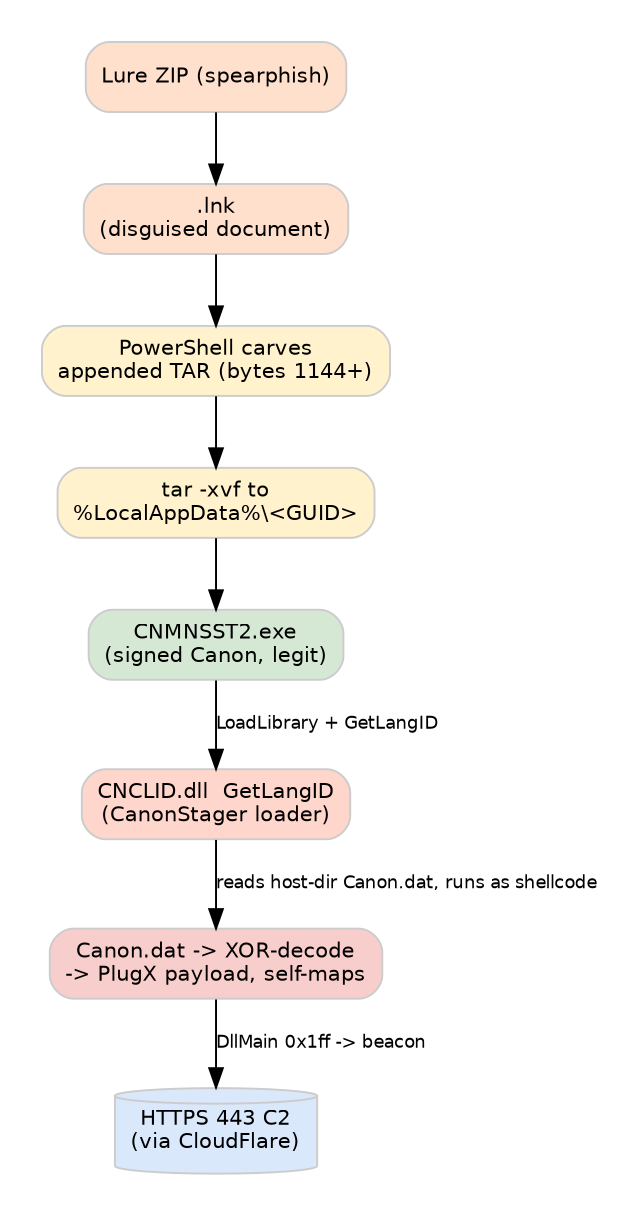
GetLangID is where the loader hides. It calls FindFirstFileW("C:\windows\*.*"), counts directories, and only when it hits the third one does it call the real loader. That’s an execution gate dressed up as a localization routine. C:\windows always has at least three folders, so it always fires.
The real loader does the part that mattered for everything afterward. It calls GetModuleFileNameW(NULL) to get the host EXE’s path, takes that directory, builds \??\<dir>\Canon.dat, opens it with NtCreateFile/NtCreateSection, and runs it as shellcode. There is no XOR loop anywhere in the loader.
flowchart TD
  A["CNMNSST2.exe launches<br/>(signed Canon host)"] --> B["side-loads CNCLID.dll<br/>from its own directory"]
  B --> C["export GetLangID called"]
  C --> D{"FindFirstFileW C:\windows\*.*<br/>count dirs ≥ 3?"}
  D -->|"always true on a real install"| E["GetModuleFileNameW(NULL)<br/>→ host EXE's own directory"]
  E --> F["build path to Canon.dat<br/>next to the host EXE"]
  F --> G["NtCreateFile / NtCreateSection<br/>map Canon.dat, run as shellcode"]
  G --> H["PlugX unpacks itself in memory<br/>— never touches disk as a PE"]
The loader carries no key and no decision logic worth hiding — the only thing worth obscuring was that step 3 exists at all.
Two facts come straight out of that, and both cost me real time:
- The XOR key lives in
Canon.dat, not the loader. I’d assumed the key was inCNCLID.dlland went looking for it across loader variants. It isn’t there. The loader is key-agnostic and interchangeable. I pulled 35 loaders later; 24 distinct code variants, not one carries a key. - The host EXE has to sit next to
Canon.dat. Because the path comes fromGetModuleFileName(NULL), you can’t justrundll32the loader and expect it to find the payload.rundll32lives in System32, so it looks forCanon.datthere and comes up empty. I burned a bunch of detonation attempts before that clicked.
Why the config won’t fall out statically
The payload is PlugX: it self-maps, calls its own DllMain with the magic reason 0x1ff, and spins up a beacon worker. The config, the part you actually want, is built into runtime memory and reached through an obfuscated computed pointer. It is not present in the file. I confirmed that the hard way: a memory dump of the running implant has the C2; the payload on disk does not.
So a file-only extractor can’t recover the C2. You need a memory image of the implant while it’s running. That means detonation, and detonating this thing has a few sharp edges:
- Clean Windows VM with the NIC removed, so the implant never reaches the real C2.
- The full triplet, together, with the host EXE next to
Canon.dat(see above). - A reliable trigger. VNC keystroke injection and
RunOnceboth flaked on me; an all-users Startup-folder.batwas the thing that fired every time. - Capture from the host side with
virsh dump --memory-only, so nothing in the guest has to cooperate. - Extract with a binary anchor, not a text grep. The config C2 is a struct:
flag:u16, port:u16, host. Searching for that[flag][port][host]shape cuts straight through the analyst VM’s pre-existing IOC noise, which agrep https://drowns in.
flowchart LR
  subgraph Static["static file — no C2 recoverable"]
    F["Canon.dat on disk"] -.->|"config only exists<br/>after self-map + DllMain(0x1ff)"| X["nothing to extract"]
  end
  subgraph Live["running implant — C2 recoverable"]
    V["isolated VM, NIC removed"] --> T["Startup-folder .bat trigger"]
    T --> R["implant runs, unpacks config in memory"]
    R --> D["virsh dump --memory-only<br/>(from the host, guest doesn't need to cooperate)"]
    D --> S["binary-anchor search:<br/>struct shape flag:u16, port:u16, host"]
    S --> C2["202.61.72.198:443 recovered"]
  end
The config exists nowhere on disk — it’s assembled in memory only after the implant runs. The only way to see it is to let it run somewhere it can’t phone home, then read the memory instead of the file.
Once that worked, the seed sample gave up 202.61.72[.]198:443 and a stream of randomly-generated beacon URIs like https://202.61.72.198/DBe4KJbFH2U117A?QF3h=.... The C2 matched the tweet, but now I had a repeatable way to get it out of any build.
From one sample to nine
With the extractor working, the question becomes: how many of these are there? VirusTotal pivots on the name, the loader export, the payload imphash, and compressed parents returned 63 related files: payloads, loaders, decrypted DLLs, and lure archives.
Cracking every Canon.dat settled the key question for good. Nine distinct payloads, nine distinct (offset, key) pairs. Each build is fresh:
| Canon.dat | stub offset | XOR key | payload export |
|---|---|---|---|
c74d7089 (seed) | 13 | 0x3C | JrdlwuiHVkO |
1e05e5ec | 12 | 0xE9 | uEnBXnfDNIj |
2889ac58 | 7 | 0x8B | GetLangInit |
418ad90f | 12 | 0x09 | VADnOYgWyvm |
542aaae7 | 9 | 0x40 | dHRytafCiJD |
58101378 | 7 | 0xC6 | uisiXjwMCAf |
6af60f9a | 10 | 0x94 | uXkwjJJsLeZ |
7e825f86 | 10 | 0x20 | qjkyOodMGlk |
f982474f | 8 | 0xCF | ZBEPBDTmLkK |
The reusable parts (a dozen copies of the legit Canon host, 35 loader variants) are shared scaffolding. What changes per build is the payload and its key. The same handful of payloads then get repackaged into many lure archives (167 distinct archives across the cluster), one decoy per target. So the C2 set is small and bounded, which means it’s mappable.
Mapping the C2s to targets
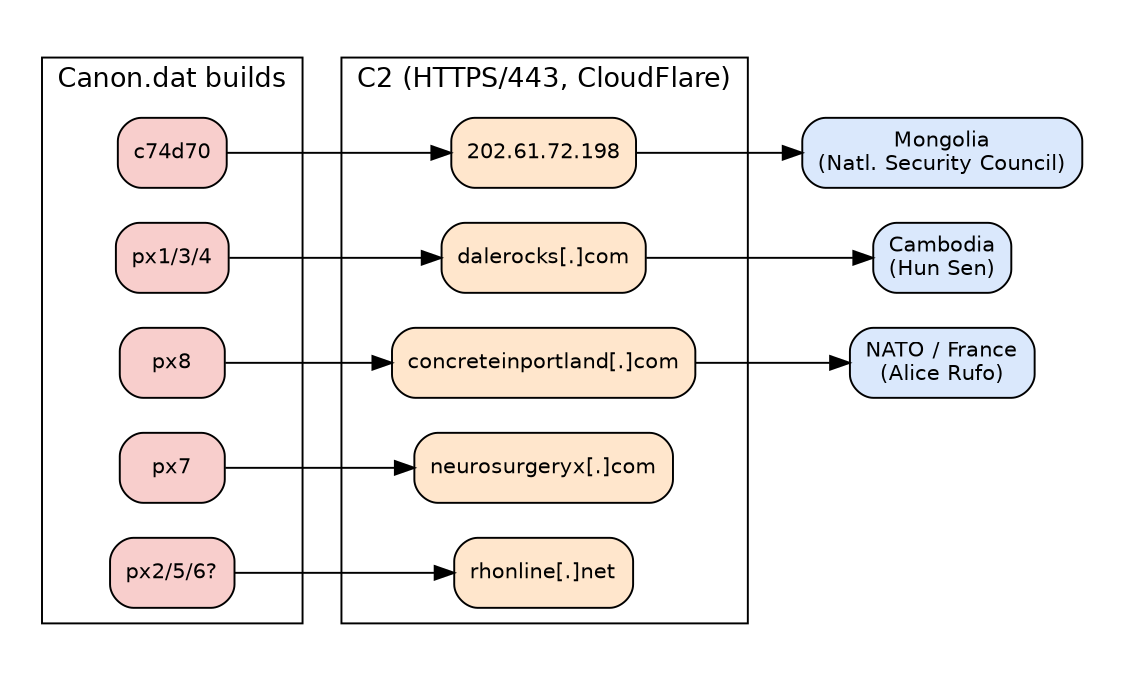
There are two ways to tie a C2 to a sample. The slow way is detonation: run the build, dump RAM, extract. The fast way is a VT pivot: a C2 domain’s communicating_files points back to the triplet ZIP, and the ZIP carries both the Canon.dat and the decoy document. The decoy is what tells you who the target was.
| C2 (HTTPS/443) | Canon.dat build(s) | decoy / target |
|---|---|---|
202.61.72[.]198 | c74d70… (seed) | Mongolia: National Security Council (ҮАБЗ) regional-security report |
dalerocks[.]com | 1e05e5ec… 418ad90f… 542aaae7… | Cambodia: “Hun Sen courtesy call” .lnk |
concreteinportland[.]com | f982474f… | NATO / France: Alice Rufo / Ankara Summit briefing PDF |
neurosurgeryx[.]com | 7e825f86… | not recovered |
rhonline[.]net | not pinned | not recovered |
So this isn’t one target. It’s a spread of governments and defense bodies: Mongolia’s national-security apparatus, Cambodian diplomacy, French/NATO defense, and probably Lithuania (more on that below). That lines up with the documented UNC6384 swing back toward EU/NATO in mid-2025.
The delivery deserves a note. The lure is a ZIP with a disguised .lnk. The .lnk runs PowerShell that finds the ZIP, carves a TAR appended to the end of it, tar -xvfs that into a GUID-named folder under %LocalAppData%, and runs the Canon host from there. The GUID folders (T80A20NS-…, QV95SH6B-…) are exactly the path prefixes you see on the Canon.dat filenames in VT.
The infrastructure
Every C2 is CloudFlare-fronted, and the domains aren’t freshly-coined nonsense. They’re drop-caught expired domains. DNS history runs back to 2014–2020 (a real Portland concrete company, a real neurosurgery site), but they were re-registered in 2025–2026 with privacy-redacted whois. They look aged and legitimate, and they’re entirely the operator’s.
The one origin that leaked did so because the seed build used a bare IP instead of a domain. 202.61.72[.]198 is a Windows VPS at GPK Group / AS9749 in Australia: nginx on 443 serving a CloudFlare Origin certificate for dreamresin[.]com, plus RDP (3389) and WinRM (5985).
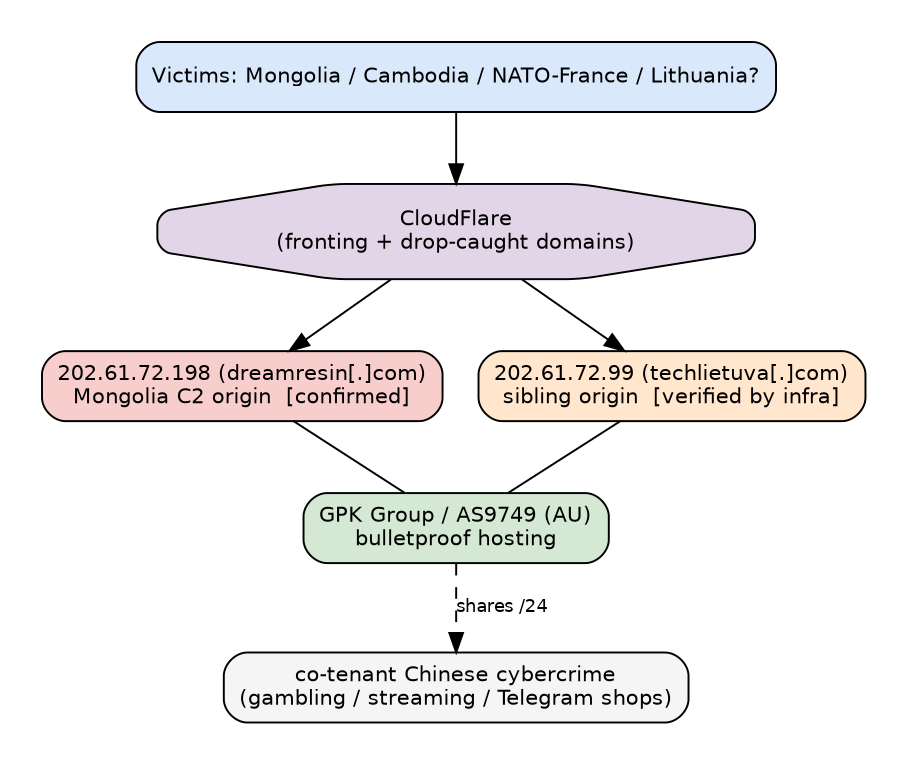
Pivoting on the hosting (asn:AS9749 plus a CloudFlare-Origin cert) turned up a sibling with the identical fingerprint. 202.61.72[.]99 fronts techlietuva[.]com, same Windows-VPS + CF-cert + RDP/WinRM profile, with a fake “Tech Lietuva” corporate front and a probable Lithuania target. The rest of that /24 is co-tenant Chinese cybercrime (gambling, streaming, Telegram-account shops), which is its own small attribution signal: shared bulletproof hosting.
This section is also where I have to show my work, because a couple of my early conclusions didn’t survive:
- VT verdicts lag. The VT API told me
dalerocks[.]comwas 0/91. The web UI said 18/92. Trust the API number as a floor, not as the truth. - Registrant clustering was a dead end. Three of the domains shared registrant hash
c6523241936df1ba, and for a minute I thought that was the operator’s fingerprint. It isn’t. It’s a generic privacy-redaction value shared by 30+ unrelated domains. Reverse-whois on it is noise. - JA3S/JARM didn’t isolate anything. The seed origin’s TLS fingerprints match 15k–127k hosts, because it’s a stock nginx+CloudFlare stack. Fingerprint pivots only help when the stack is unusual; here, the hosting-plus-cert pivot is what worked.
What the malware can’t tell you
There’s no victim count in here. That lives on the C2 side. You’d need to sinkhole the domains, or have CloudFlare or law enforcement enumerate the connections, which is how the larger PlugX botnets got counted. The binaries give you targeting, not a victim list. With government and defense decoys and only a handful of submissions per sample, this looks like a targeted operation rather than a broad one: a small set of high-value victims, not a botnet.
One confidence note worth stating plainly. techlietuva[.]com is tied to the campaign by infrastructure, not by a captured beacon. These FUD payloads don’t detonate in public sandboxes, so there’s no sample on record talking to it. The link rests on it being co-located with the confirmed origin and running the identical server profile: a Windows VPS with a CloudFlare Origin cert and RDP/WinRM exposed, in the same /24. Strong, but circumstantial, and worth saying so rather than overstating it.
Indicators
# C2 (all HTTPS/443)
202.61.72[.]198                  IP C2 (Mongolia); origin: GPK Group / AS9749 (AU)
dalerocks[.]com                  domain C2 (Cambodia); CloudFlare-fronted
concreteinportland[.]com         domain C2 (NATO/France); CloudFlare-fronted
neurosurgeryx[.]com              domain C2; CloudFlare-fronted
rhonline[.]net                   domain C2; CloudFlare-fronted

# Origins / decoy fronts
202.61.72[.]198   202.61.72[.]99    Windows-VPS origins (CF Origin cert + RDP + WinRM), GPK Group/AS9749
dreamresin[.]com  techlietuva[.]com decoy front sites on the origins

# Triplet
CNMNSST2.exe / CNMNSST.exe        signed Canon host (legit, abused)
CNCLID.dll (export GetLangID)     CanonStager loader
Canon.dat                         XOR'd PlugX payload (9 builds; keys 09 20 3c 40 8b 94 c6 cf e9)

# Delivery
*.lnk -> carves appended TAR -> %LocalAppData%\<GUID>\CNMNSST.exe
GUID folders: T80A20NS-  QV95SH6B-  DHJ0I9RK-  VD1B12N4-  43OZ1LSA-
Detection
Per-build keys and per-build export names make fixed-string signatures brittle. The robust move is to unpack generically: brute the stub offset and single-byte key and validate the result is a PE. That’s key-agnostic, so it survives the per-build rotation:
def is_canon_dat(data):
    for off in range(64):
        key = data[off] ^ 0x4D                       # assume first byte decodes to 'M'
        if data[off+1] ^ key != 0x5A: continue       # 'Z'
        hdr = bytes(b ^ key for b in data[off:off+0x400])
        e = int.from_bytes(hdr[0x3c:0x40], 'little')
        if 0 < e < len(hdr)-4 and hdr[e:e+4] == b'PE\x00\x00':
            return off, key
    return None
For hunting at rest, the strongest signal is the combination, not any one file: a signed Canon CNMNSST2.exe / CNMNSST.exe, a CNCLID.dll that exports GetLangID but isn’t Canon’s, and a sibling Canon.dat blob, all sitting together in a user-writable or %LocalAppData% GUID folder. None of the three is malicious alone. The triplet is.
Where this fits
This is a newer (2026) cut of CanonStager. The 2025 reporting describes an RC4-with-16-byte-key loader using cnmpaui.exe / cnmpaui.dll / cnmplog.dat against Hungarian and Belgian diplomats. This variant swaps in single-byte XOR, a different Canon host (CNMNSST2.exe, the IJ Network Scanner), and a fresh set of C2s, none of which return any OSINT hits. Same actor, same playbook, new build and new infrastructure.
The reusable part is the tooling: a Canon.dat decryptor, a memory config extractor, an XOR-key cracker. If another Canon.dat shows up, the path from blob to C2 is now a known quantity.
References: Arctic Wolf — UNC6384 / CanonStager, The Hacker News, Recorded Future — RedDelta. Original sample via @mopisec.